Benchmarks
Gemini 4 Neon benchmarks: where the model card numbers come from
Gemini 4 Neon tops 16 of 19 rows in Google's table. The methodology document shows who measured each number and where the comparison is not like for like.
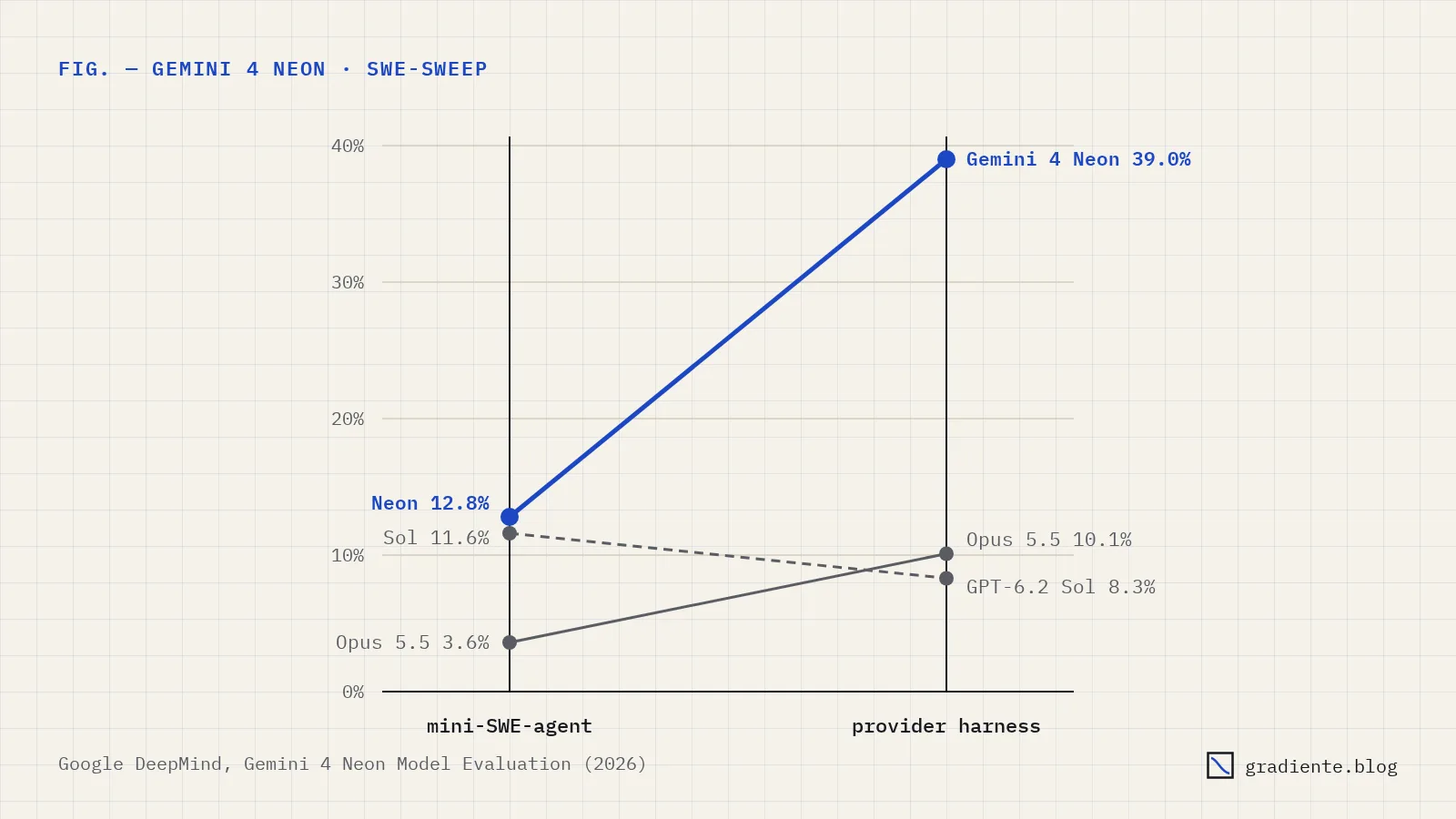
Google released Gemini 4 Neon on November 18, 2026. Its model card carries a 19-row table comparing it with Claude Opus 5.5 and GPT-6.2 Sol, and Neon comes first in 16 of those rows. The row that stands out is SWE-sweep, a bug-hunting benchmark, where Neon scores 39.0% against 10.1% for Opus 5.5 and 8.3% for Sol.
Where each number comes from is in a separate evaluation methodology document, and it changes how several rows read: Google ran nine of the 19 results itself, rival numbers are mostly self-reported by their providers, and in at least seven rows the models were measured under different conditions.
What shipped
The model card says Neon "is adapted from Gemini 4 Carbon" and points to Carbon's card for architecture, training data, hardware and software. Neon's own card adds nothing new on those points. In the launch post, Google places it between its siblings: Carbon handles the hardest, long-horizon projects, Hydrogen handles fast everyday execution, and Neon "balances depth and efficiency".
| Item | Gemini 4 Neon | Source |
|---|---|---|
| Input | text, images, audio and video | model card |
| Context | up to 1M tokens (input + output) | model card |
| Output | up to 64K synchronous; up to 1M via background long decode | model card |
| Knowledge cutoff | March 2026 | model card |
| Price ($/M tokens) | 3 input; 0.15 cached; 15 output | launch post |
| Thinking levels | four, including "high" (default) and "xhigh" | launch post |
It is available in the Gemini API, Google AI Studio, Gemini for business, Google Antigravity and the Gemini app for paying subscribers.
Reading the table: who measured what
The methodology document opens with the general rules. Neon's numbers are pass@1 (a single attempt, with no majority voting or parallel test-time compute), run through the Gemini API at the highest thinking setting unless noted otherwise. Safety filters stay on, except for the cybersecurity evaluations. For smaller benchmarks, Google averages over "multiple trials"; only two rows give the count (five attempts per task on Terminal-Bench-Science, three on SEC-bench Pro).
The rule that matters most comes next: results for non-Gemini models "are sourced from providers' self-reported numbers" unless another source is named. For Opus 5.5 and GPT-6.2 Sol, Google uses the maximum reasoning setting and, when that number is not available, the "best available reasoning results".
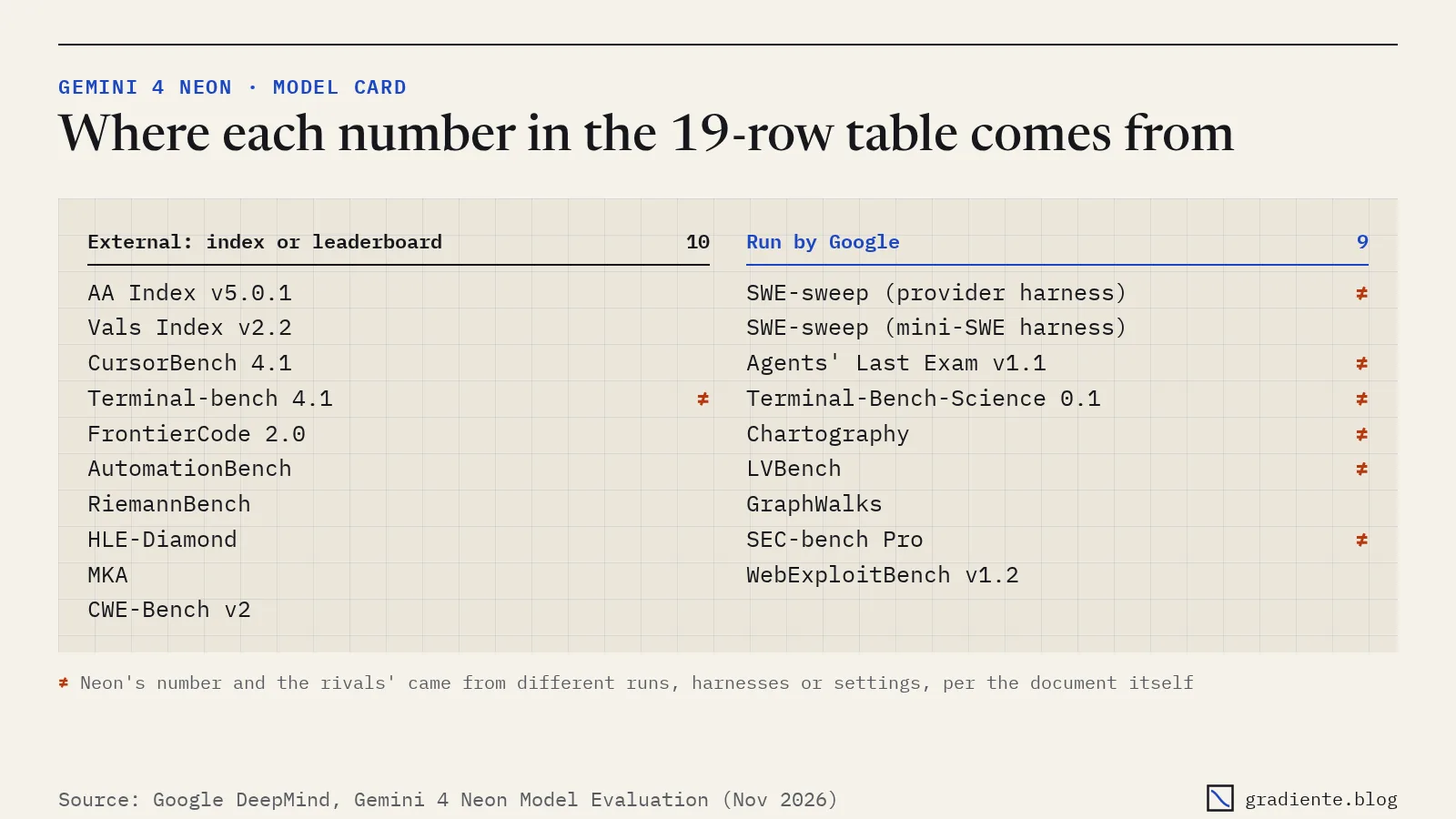
Sorting the rows by origin:
- Ten come from outside: indices such as the Artificial Analysis Intelligence Index and the Vals Index, or public leaderboards such as FrontierCode, AutomationBench, RiemannBench and CWE-Bench v2.
- Nine were run by Google: both SWE-sweep rows, Agents' Last Exam, Terminal-Bench-Science, Chartography, LVBench, GraphWalks, SEC-bench Pro and WebExploitBench.
- In at least seven, conditions differ between models, by the document's own account. Some examples: on Terminal-bench 4.1, Neon's number comes from Artificial Analysis using the Antigravity-CLI 1.5.9 harness, while the rivals' come from the official leaderboard. On Agents' Last Exam, Neon ran with Antigravity-CLI 1.4.8 and a five-hour window, Sol's score comes from OpenAI's system card and Opus's from the leaderboard.
The clearest case is LVBench, a video-understanding benchmark: Neon got video at 1 frame per second, GPT-6.2 Sol got 500 frames and Opus 5.5 got 600, "due to API limitations". With different inputs, Neon's 89.0% against Sol's 87.6% tells you little about which model understands the same video better.
SWE-sweep: one test, two harnesses
SWE-sweep is a preprint from researchers at Meta, Harvard, the University of Washington and Stanford, dated October 1, 2026. The agent gets a whole repository containing many bugs at once and no hint about what is wrong or where. It must find and fix as many as it can without breaking the original test suite. The benchmark has 4,068 bugs across 100 repositories and 22 languages, with a limit of 1,000 steps and 12 hours per repository. In the paper, the best model, GPT-5.6 Sol (xhigh), resolves 4.7% of bugs.
A harness (or scaffold) is the program around the model: the tools it can call, how history is kept, how steps are chained. Google's table reports SWE-sweep under two:
| Model | mini-SWE-agent | Provider harness | Harness used |
|---|---|---|---|
| Gemini 4 Neon | 12.8% | 39.0% | Antigravity-CLI 1.5.9 |
| Claude Opus 5.5 | 3.6% | 10.1% | Claude Code |
| GPT-6.2 Sol | 11.6% | 8.3% | Codex |
mini-swe-agent is an agent of about 100 lines that uses only bash; its README says it makes a good baseline because it puts "the language model (rather than the agent scaffold)" at the centre. It is the harness behind every entry on the official leaderboard, where Opus 5.5 shows the same 3.6% as in Google's table. Neon and GPT-6.2 Sol are not on the leaderboard as of its November 2 update.
With the same plain harness, Neon leads Sol by 1.2 points. With each company's own harness, the gap becomes 30.7 points. Google explains part of this: Antigravity-CLI ships a default tool that fans sub-agents out across the codebase, which Google calls "particularly suited" to bug finding. Google computed all three provider-harness numbers itself, and the document says they all use "subtask-weighted reward", a metric it does not define. The paper's metric is the percentage of bugs resolved; there is no basis for assuming the two are the same.
The paper also tested provider harnesses on a subset of repositories and saw no significant gain: GPT-5.6 Sol scored 1.6% with Codex against 2.9% with mini-SWE-agent, and Claude Opus 5 scored 1.1% with Claude Code against 1.0%. Since the models, versions and metrics differ, the two measurements do not contradict each other. They show that the "provider harness" row measures model plus tooling, not the model alone.
The paper also explains why tooling matters here: with the original issue texts in the prompt, GPT-5.6 Sol jumps from 4.8% to 75.3% on the first 20 repositories. Finding the bug is the hard part, and sub-agents that spread the search across the code go straight at it.
What the card says about safety
Neon's safety assessment was a "Material Capability Change" (MCC) check under the Frontier Safety Framework, comparing it with Gemini 4 Argon. According to the card, Neon showed a gain in general capability that fell below the threshold, so a full suite of critical capability evaluations "was not required". Every determination is carried forward from Argon:
- Biological (CBRN): critical level "cannot be ruled out".
- Cybersecurity: critical level "cannot be ruled out".
- Loss of control, stealth and situational awareness: TCL "cannot be ruled out" (the card uses TCL here, not CCL, and expands neither).
- Chemical, radiological and nuclear, harmful manipulation, and ML R&D: not reached.
The card gives neither the MCC threshold value nor the evaluations behind the check; it points to a separate Safety & Security Report for full results. Content-safety metrics compare Neon with Hydrogen and, per the card, are automated evaluations, "not human evaluation or red teaming".
What the documents leave out
- Architecture, training data and the MCC threshold, as noted above.
- How many trials go into the averages for the other smaller benchmarks, and confidence intervals for the capability rows.
- A definition of "subtask-weighted reward" for SWE-sweep.
- Independent checks of the nine rows Google ran itself; only WebExploitBench is described as validated by a third party, AgentCyberRange.
What this changes for you
- If you are picking a model for a coding agent, the 39.0% describes Neon inside Antigravity-CLI. In another harness, the closer reference is the mini-SWE-agent row (12.8% against Sol's 11.6%); test it in your own workflow.
- If you compare models from launch tables, lean on the rows from external indices and leaderboards, where the yardstick is shared. It is the same care we suggested with GPT-6.2's self-reported numbers.
- If you work with video, draw nothing from LVBench: the table compares inputs at different frame rates.
- If you follow AI safety, Neon inherited Argon's determinations by staying under a threshold whose value the card does not give.
FAQ
How much does Gemini 4 Neon cost in the API?
According to Google's launch post, $3 per million input tokens, $0.15 per million cached input tokens and $15 per million output tokens, with a 1 million-token context window.
What is the difference between Gemini 4 Neon, Carbon and Hydrogen?
Google positions Carbon for the hardest, long-horizon projects, Hydrogen for fast everyday execution, and Neon in between, balancing depth and efficiency. The model card says Neon is adapted from Gemini 4 Carbon.
Were Gemini 4 Neon's benchmarks measured independently?
Partly. Ten of the 19 rows come from external indices or leaderboards; Google ran the other nine itself. Competitor numbers are, by default, the providers' self-reported results.
What is SWE-sweep?
A 2026 benchmark in which an agent gets a whole repository with no bug report and must find and fix as many bugs as it can. It covers 4,068 bugs across 100 repositories and 22 languages.
Sources
- Google DeepMind — Gemini 4 Neon Model Card (Nov 18, 2026)
- Google DeepMind — Gemini 4 Neon Model Evaluation: approach, methodology & results (Nov 2026)
- Google — Introducing Gemini 4 Neon (Nov 18, 2026, updated Nov 23, 2026)
- Lieret et al. — SWE-sweep: Can Agents Autonomously Find and Fix Bugs? (preprint, Oct 1, 2026)
- SWE-sweep — official leaderboard (updated Nov 2, 2026)
- SWE-agent — mini-swe-agent (GitHub repository)